
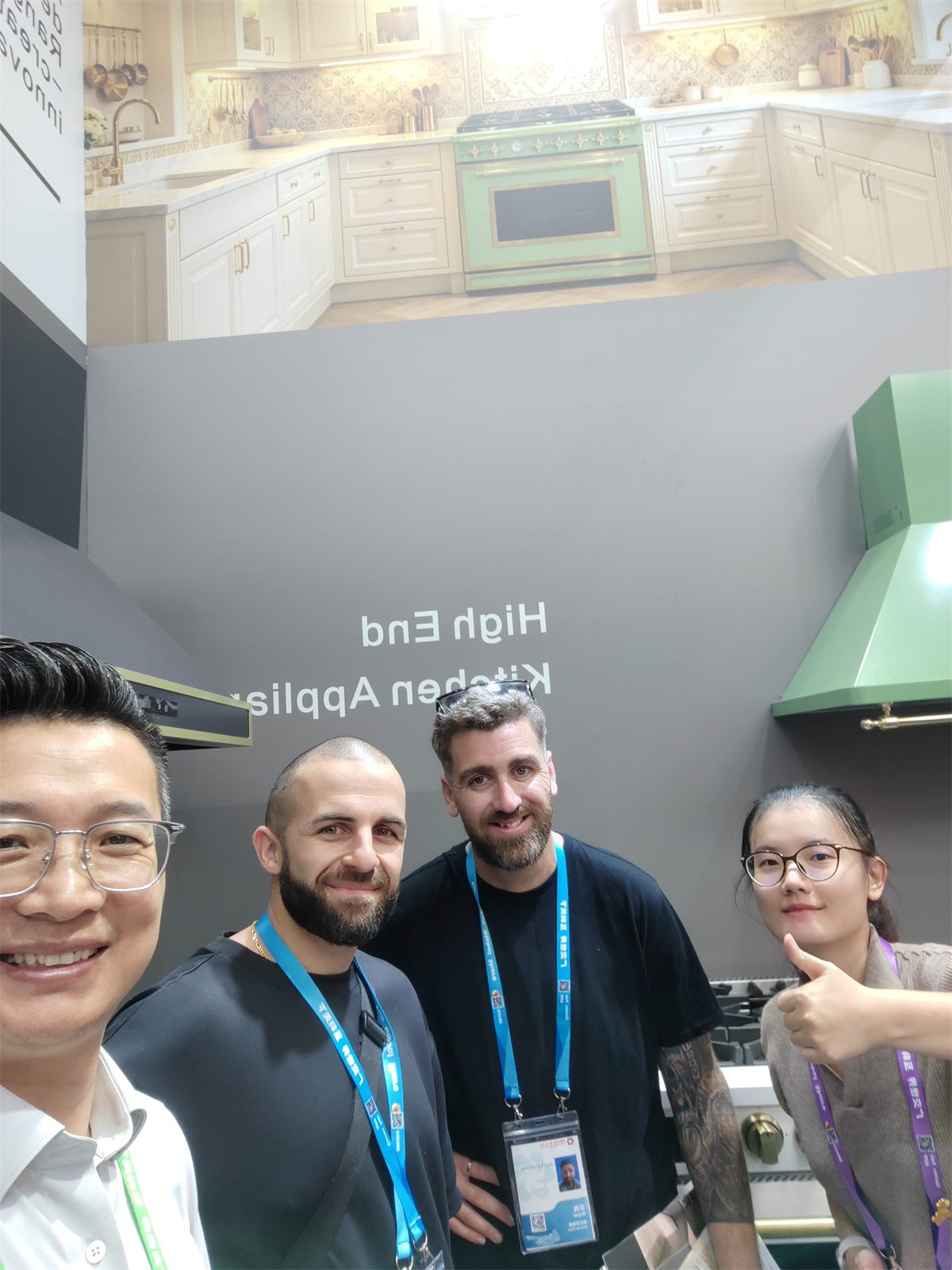
Short answer: ask who makes the body, on which line, and what happens when your specification falls outside it. At Canton Fair 140 we watched buyers spend most of their meeting on the third question, and it is the right one — a supplier who can name the platform, the line and the spare-parts list in the first call is usually the one who can also hold a delivery date.
Three days at the 140th Canton Fair, more than forty conversations at the stand, and one pattern worth writing down: the opening question was no longer the unit price. It was the file, the container and the platform.
Documents come first. Buyers arrived with a checklist - test reports, declaration of conformity, the certification scheme for their market, a spare-parts list with part numbers, a packing list with carton dimensions. A gas range supplier who can hand these over at the second meeting moves to the front of the queue; one who says we will send it later is rarely called back.
The first order is a mixed container. Instead of 500 units of one model, we were asked for a 40HQ with three widths and two colours, or a mix of ranges and matching hoods. That is also how a range hood manufacturer is judged: can the hood be sized to the same width, in the same finish, without a separate tooling budget.
One platform, four widths. Buyers want 24, 30, 36 and 48 inch bodies that share burners, controls and spares, and hoods sized to match. Nobody wants four spare-parts inventories for one showroom. A gas range supplier with one platform answers that in a sentence; a trader with ten unrelated models cannot.

Where we were honest about limits: trial quantities are quoted per configuration, not from a price list, and a mixed 40HQ takes longer to build than a single-model container. A range hood manufacturer that claims otherwise is usually quoting from a catalogue rather than a production plan.
What that looks like in daily work: a defined enquiry comes back as a written configuration with packing dimensions and container count, not a verbal yes; every unit is function-tested before packing; test reports, declaration of conformity, spare-parts list and loading plan travel with the goods; and when a request falls outside the platform, we say so and offer the closest alternative instead of agreeing to everything.
Where this pays off in practice is procurement: when a project needs ranges, hoods, hobs, ovens and sinks together, the interfaces between them fail more often than the appliances do. Cut-out dimensions, duct diameter and colour across different vendors are the usual culprits. Consolidating the purchase with one factory removes that risk, and it also shortens the paperwork — one specification sheet, one inspection report, one loading plan for the container.
If your next order has to survive a price negotiation in twelve months, the answer is in these three points rather than in the unit price. And if you are choosing a gas range supplier or a range hood manufacturer now, ask for the documents, the container plan and the platform drawing before you ask for the discount.