
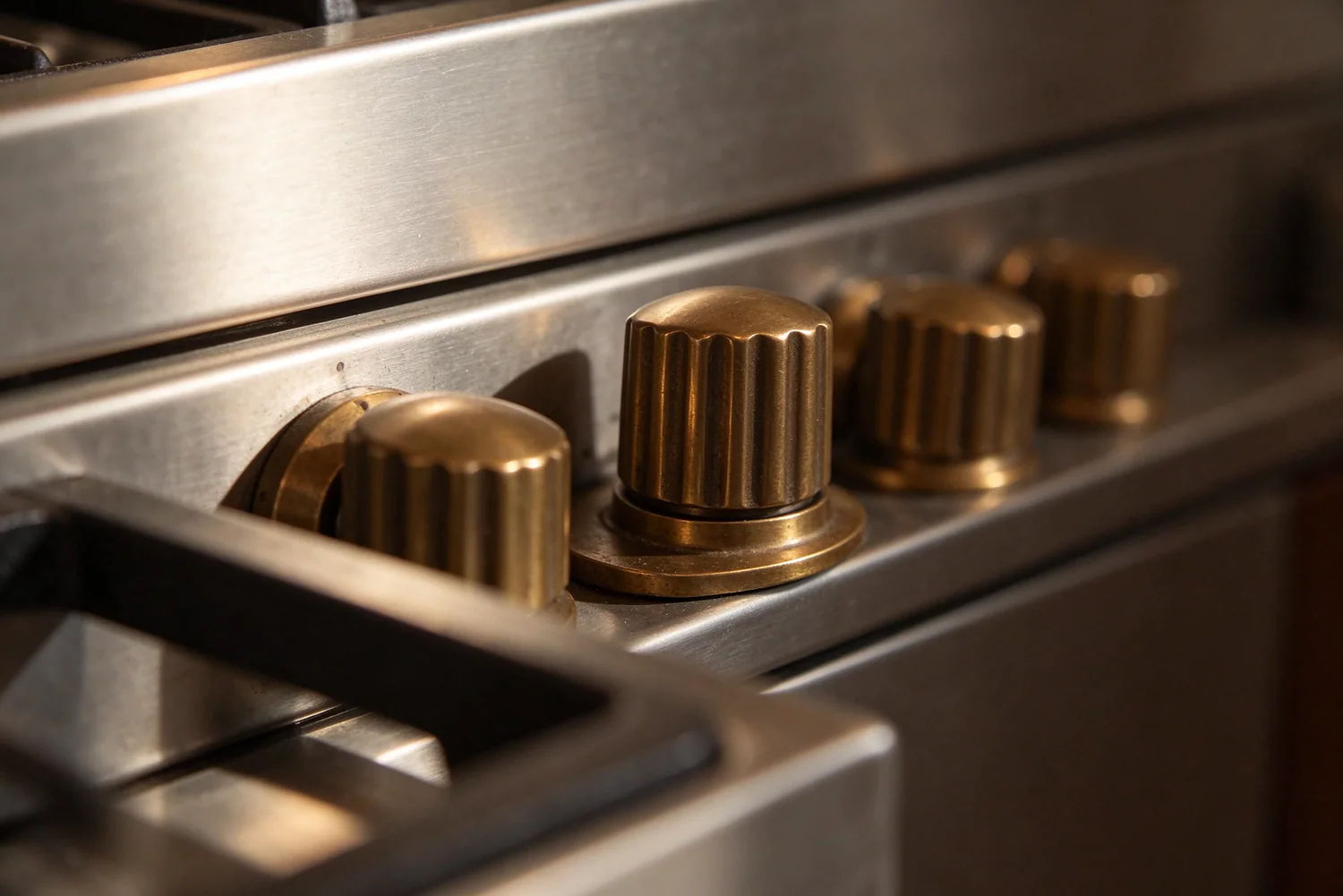
Short answer: whole-house stainless is not a separate catalogue bolted onto the appliances; it is the same 304 sheet, grain direction and edge detail, drawn on the same set of shop drawings. Worktops, cabinet fronts, splashbacks, island cladding and sinks are fabricated next to the ranges, so the finish matches across a kitchen under the same light. A custom kitchen appliance manufacturer earns this work by controlling the sheet, not by reselling it.
The specification is 304 stainless throughout, with brushed, hairline or mirror finish and welded-and-ground or folded edge details. Because stainless steel kitchen appliances and the fabricated surfaces are cut from the same coil family, a mirror panel and a mirror splashback stay visually consistent — the usual failure in mixed sourcing is a different grain direction or a different polish.
This line is drawn per project, not stocked: send a kitchen layout and elevations, and you receive a shop drawing, an edge-detail sheet and a price, with drawings approved before any sheet is cut. Where a project mixes widths — 30 inch in a pantry, 48 inch in the main kitchen — one drawing carries all the appliance cut-outs, so the fabricator and the appliance line never work from two different sets of numbers.
For OEM and private-label buyers this can be one purchase order: ranges, hoods, sinks and the fabricated stainless steel kitchen appliances on one specification sheet, one inspection, one loading plan. That is what a custom kitchen appliance manufacturer is actually asked for — one party accountable when a splashback does not meet a worktop. Third-party items such as taps can be consolidated into the same container when the specification calls for it.
To start, send the layout, the finish and the edge detail you want; the reply is a drawing and a price, not a catalogue page. When comparing suppliers, ask a custom kitchen appliance manufacturer whether the stainless steel kitchen appliances and the fabricated surfaces come from the same sheet and the same shop — that answer explains most of the fit problems buyers report six months later.